
Let’s be real for a second, there is practically no sound in the world more stressful than the “drip, drip, drip” of water hitting your floorboards during a heavy rainstorm. It’s the kind of sound that keeps you up at night, wondering just how much damage is happening right above your head.
Here in Philadelphia, we put our roofs through the wringer. Between the humid, storm-heavy summers and those freezing, thawing, refreezing winters, your roof is working overtime 24/7. Whether you’re living in a classic row home in South Philly, a twin in the Northeast, or a single-family home out in the suburbs, the reality is the same: your roof is the only thing standing between your living room and the elements.
The problem is, by the time you actually see water dripping into your house, the leak has probably been there for a while. Water is sneaky. It travels. It finds the path of least resistance. That dark spot on your ceiling? It might be originating from a cracked shingle or a popped seam ten feet away.
We’ve spent decades up on roofs across the Delaware Valley, and if there’s one thing we tell every homeowner, it’s this: catch it early, and you save your wallet. Catch it late, and you’re looking at a much bigger headache. So, how do you spot a leak before it turns into an indoor swimming pool? Let’s break it down.
Start Inside: The Subtle Warning Signs
You don’t need a ladder to start your inspection. In fact, the best place to start looking for a roof leak is right inside your house, with your feet firmly on the ground. You need to know what to look for.
The “Stain” That Wasn’t There Yesterday
We’ve all ignored a spot on the ceiling, hoping it was just a shadow or maybe a trick of the light. But if you see a discoloration, usually yellow, brown, or a faint copper ring, on your ceiling or high up on your walls, that is almost certainly water.
In a multi-story Philly row home, don’t just check the top floor. Water can travel down through wall cavities and show up on the first floor or even in the basement. If you see a stain, touch it (if you can reach it). Is it damp? Is the drywall soft? Even if it’s dry now, that stain is a history lesson telling you that water has been there before.
Paint That’s Acting Weird
Paint shouldn’t bubble, peel, or crack on its own. If you see your paint blistering or looking like it’s pulling away from the wall, there is moisture behind it, pushing it out. This is super common near where walls meet ceilings. It often looks like an ugly blister. Don’t pop it without a bucket underneath, because you might be surprised by how much water is trapped there.
The Smell of “Old Attic”
You know that smell- it’s musty, earthy, and damp. It smells like an old basement, but if you’re smelling it in your upstairs bedroom or hallway, you’ve got an issue. Mold and mildew love dark, wet environments. If water is seeping into your insulation or attic space, mold can start growing within 24 to 48 hours. If your nose tells you something is wet, trust it.
The Attic Inspection (If You Have One)
For those of you with accessible attics (we know some of you in flat-roof row homes have a crawl space or nothing at all), this is your front line of defense.
Pick a rainy day if you can, or go up there right after a storm. Bring a strong flashlight. You aren’t just looking for water, you’re looking for light. If you turn off your flashlight and see beams of daylight poking through the roof boards, you’re in trouble. If light can get in, water definitely can.
Look at the insulation. Is it matted down? Insulation should be fluffy. If it looks flat and heavy, it’s been wet. Check the wood rafters for dark streaks or white, powdery mildew. These are all signs that your roof is compromised.
The Exterior Check: What’s Happening Up Top?
Okay, now let’s talk about the outside. Safety first: We don’t want you climbing up on a steep roof if you aren’t comfortable or experienced. You can see a lot just by walking around your house with a pair of binoculars, or climbing a ladder just to the gutter line without actually getting on the roof.
The Shingle Situation
If you have a pitched roof (the triangle kind, for those new to roofing terms), your shingles are your armor.
- Curling: Shingles should lie flat. If the edges are curling up like a stale potato chip, they aren’t sealing your roof anymore.
- Missing Shingles: This one is obvious. If you see bare spots, that’s a direct invitation for water to enter.
- Granules in the Gutter: Next time you clean your gutters (we’ll get to that in a minute), look at the gunk you pull out. If it looks like a lot of black sand, those are the protective granules from your asphalt shingles. Once those are gone, the sun bakes the shingle, it cracks, and leaks start.
The Flat Roof Reality (Philly Special)
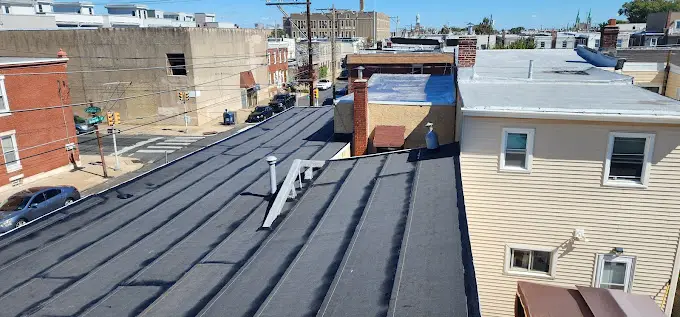
If you live in Philadelphia, there’s a good chance you have a flat roof. These beasts are different. You don’t have shingles; you likely have a modified bitumen (rubber) roof or a “silver-coated” roof.
- Pooling Water: Flat roofs are rarely perfectly flat; they have a slight pitch to drain water. If you look up there 48 hours after a rainstorm and still see a “pond” of water, that’s a problem. Standing water breaks down the roofing material way faster than shedding water does.
- Cracked Coating: That silver coating isn’t just for looks; it reflects UV rays. If you see it cracking, peeling, or looking like dried mud, your roof membrane is exposed.
- The Parapet Walls: In row homes, the walls that stick up on the sides of your roof are called parapet walls. The flashing (the metal or membrane seal) where the roof meets the wall is a major leak zone. If that seal looks loose or torn, water is running right behind it and down into your walls.
The Silent Killer: Flashing and Penetrations
Here is a trade secret: Roofs rarely leak in the middle of a shingle or a rubber sheet. They leak where things interrupt the roof. We call these “penetrations.”
Think about your chimney, your skylights, your vent pipes, or that satellite dish the previous owner left up there. Anywhere you cut a hole in a roof to stick something through, you have to seal it. That seal is usually metal flashing and some heavy-duty caulking or tar.
Over time, metal rusts and caulking dries out and cracks.
- Chimneys: Check the metal strip around the base of your chimney. Is it rusted? Is it pulling away from the brick?
- Vent Boots: Those little pipes sticking out of your roof have a rubber “boot” around them. After 7 to 10 years of Philly summers, that rubber cracks. It’s a cheap part, but if it fails, water runs straight down the pipe and into your bathroom ceiling.
- Skylights: We love natural light, but skylights are notorious for leaking if not installed perfectly. If you see water stains specifically around the corners of your skylight, it might not be the glass; it’s likely the flashing kit around it.
Why Philadelphia Weather is a Roof’s Worst Enemy
You might wonder, “Why does my roof leak now? It was fine last year.”
Blame the zip code. In this part of the country, we deal with the freeze-thaw cycle. It rains during the day, water gets into tiny cracks in your roof material, and then at night, the temperature drops below freezing. That water turns to ice and expands. It pushes that tiny crack open just a little bit wider. Repeat that process twenty times over a winter, and by spring, you have a hole big enough to let water in.
Also, we have old housing stock. Many Philadelphia homes are 80, 90, or 100-plus years old. The structures shift and settle. When your house settles, it can pull apart seams on the roof, especially in row homes where you share a roofline with a neighbor. (Pro tip: If your neighbor is getting a roof leak repair, you should check yours too.)
The Danger of “Waiting it Out.”
We get it. Nobody wants to spend money on home repairs if they don’t have to. You might see a little stain and think, “I’ll put a coat of Kilz paint on that and worry about it later.”
Please don’t.
Water damage is progressive. It doesn’t stop-wet wood rots. Wet insulation stops insulating (sending your heating bills up). And the big one: mold. Once mold gets into your drywall and framing, the remediation costs can be ten times the cost of a simple roof patch.
A small leak repair might cost a few hundred bucks. A structural repair because a rafter rotted out? That’s a whole different conversation.
When Is It an Emergency?
Sometimes, you don’t get the luxury of “spotting it early.” Sometimes, a tree branch comes down in a storm, or a massive ice dam rips your gutter off.
If water is actively pouring into your living space, or if your ceiling is sagging like a water balloon, you are past the inspection phase. You need emergency roof repair Philadelphia residents trust to get out there fast.
In this situation:
- Move your stuff: Get furniture and electronics away from the leak.
- Catch the water: Buckets, pots, trash cans.
- Relieve the pressure: If the paint is bubbling and holding water, poke a small hole in it with a screwdriver to let the water drain into the bucket. It sounds counterintuitive, but it stops the water from spreading across the ceiling and collapsing a larger section of drywall.
- Call a pro: Don’t go up on a wet, damaged roof during a storm. It’s not worth your life. We have the gear and the experience to tarp it off safely until the weather clears for a permanent fix.
DIY vs. Calling the Pros
Can you fix a roof leak yourself? Maybe. If it’s just a matter of swiping some roofing tar over a small crack on a flat roof, a handy homeowner can handle that. But you need to know exactly what you’re fixing. We’ve seen plenty of folks go up, slather tar over the wrong spot, and trap water inside the roof, making the rot worse.
If you’re dealing with:
- Steep pitches
- Chimney flashing (requires metalwork)
- Unknown leak sources (water is coming in here, but the hole is where?)
- Slate roofs (don’t walk on these, you will break them),
Then it’s time to call in the cavalry.
Your Roof Is Your Home’s Helmet
Think of your roof as your home’s helmet. You wouldn’t play football with a cracked helmet. Likewise, you shouldn’t live under a compromised roof.
Spotting a leak early isn’t about being paranoid; it’s about being a smart homeowner. It’s about taking twenty minutes every spring and fall to walk around, look up, and make sure everything looks tight and right.
If you’re unsure about what you’re seeing, or if you want peace of mind, that’s what we’re here for. We know these Philadelphia roofs because we’ve been working on them for years. Whether it’s a quick tune-up, a fresh coat of silver on a row home, or a full roof leak repair Philadelphia project, we handle it with the same care we’d give our own mom’s house.
Keep your eyes open, check those ceilings, and stay dry out there.