
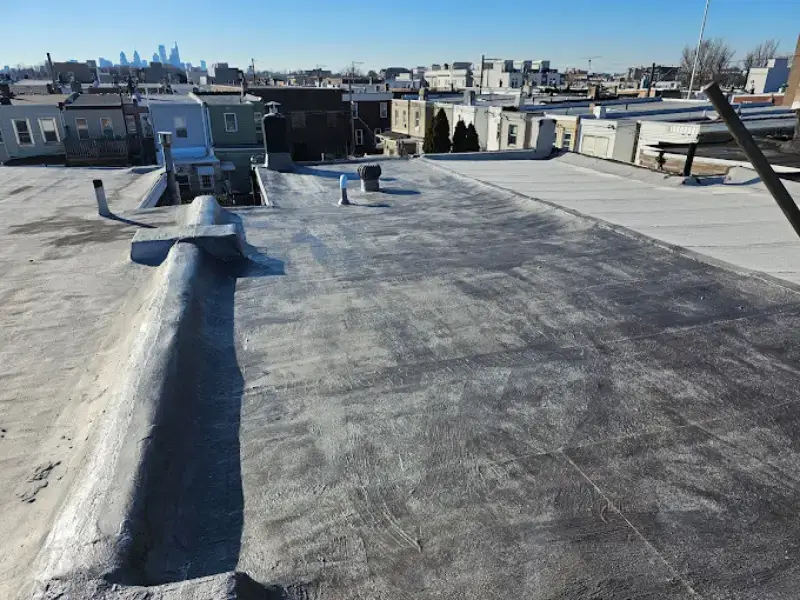
We were driving the trucks down I-95 the other morning, sitting in that inevitable construction traffic near the stadium, just looking at the skyline. When you do what we do for a living, you don’t just look at the city, you look at the roofs. And let us tell you, from the row homes in South Philly to the singles out in Bensalem, we see a whole lot of ticking time bombs up there.
It’s not because the materials are bad. It’s not even because the installers were cutting corners. It’s because folks in Philadelphia tend to treat their house like a collection of separate parts instead of one big, breathing system.
We get it. You’re busy. You look up, see a missing shingle, and think, “We’ve got to get that fixed eventually.” Or you see a tree growing out of your gutter and think, “We’ll get the ladder out next weekend.” But after 20 years of crawling on knees, hauling bundles of shingles, and hanging off the sides of three-story row homes, we can tell you this for a fact: your roof and your gutters are married. And like any marriage, if one stops pulling their weight, the whole thing falls apart.
At Discounted Roofing LLC, we spend half our time fixing roofs that don’t need to be broken. They broke because the gutters failed them. And we fix gutters that are failing because the roof was shedding debris like a husky in July.
If you want to save yourself a massive headache, and we’re talking about the kind of headache that involves buckets in your living room and a call to your insurance adjuster, you need to understand why these two work hand in hand.
The “Philly Special” Weather Beating
Let’s be real for a second about where we live. We aren’t in sunny California or dry Arizona. The Philadelphia weather is brutal on a home. We get those humid, sticky summers where the air feels like soup, followed by thunderstorms that dump three inches of rain in twenty minutes. Then, winter hits, and we get that nasty freeze-thaw cycle.
That freeze-thaw is the silent killer, and it’s something we preach about constantly.
Here is what happens: It rains during the day. The water sits in a clogged gutter or on a flat roof with poor drainage. The sun goes down, temperatures drop to 20 degrees, and that water turns to ice. When water freezes, it expands. It pushes metal apart. It lifts shingles. It cracks masonry.
If the roof maintenance in Philadelphia weather demands isn’t up to scratch, you are basically inviting that ice to tear your house apart. We’ve seen 100-year-old box gutters on row homes that were split wide open because of ice, sending water pouring into the walls every time it rained. It’s a mess, and it’s expensive to fix. But more importantly, it’s preventable if you respect the weather.
The Gutter: It’s Not Just a Trough
Most people think gutters are just there to keep rain off their heads when they walk out the front door. That’s dead wrong.
Your gutter is the bodyguard for your foundation and your roof deck. Its only job is to take the water from the roof sheds and get it away from the house. When it gets clogged, it stops being a drain and starts being a tub.
One of our crews climbed a ladder last November to check a leak on a nice two-story place near Frankford Ave. The homeowner swore the roof was leaking. We got up there, and the roof looked fine. But the gutters? Packed solid. Wet, rotting leaves, “helicopters” from maple trees, sludge, you name it.
The water had nowhere to go. So, it filled up the gutter and started backing up under the shingles. It soaked the plywood decking (the wood your roof sits on), rotted it out, and then started dripping into the attic insulation.
The homeowner thought he needed a new roof. He didn’t. He just needed clean gutters five years ago. That’s the tragedy of it. A simple cleaning job could have saved him thousands in repairs. This is why we tell everyone: don’t look at the gutter as an accessory. It is the plumbing for your roof.
The Roof: Don’t Send Trash Downstream
Now, let’s flip the coin. Your roof can destroy your gutters, too.
Asphalt shingles are covered in little rock granules. They protect the asphalt from the sun. As a roof gets older, it starts to shed those granules. Next time it rains, go look at the bottom of your downspout. See that black sandy stuff? Those are your granules.
When you ignore your roof, it sheds that sand into the gutters. That sand is heavy. It creates a thick, muddy sludge at the bottom of the gutter that doesn’t wash away with just rain.
This sludge holds water like a sponge. It adds a ton of weight to the gutter system. We’ve seen aluminum gutters literally pulled off the fascia board because they were so heavy with wet roof sludge. Once the gutter pulls away, water starts running down your siding, rotting out your window frames and your fascia board.
So, you see? A bad roof ruins good gutters. Bad gutters ruin a good roof. They are in this together.
The Row Home vs. The Suburban Home
One thing we pride ourselves on is knowing the difference between a Fishtown row home and a Croydon rancher. They handle water differently.
- The Row Home: These often have “box gutters” or internal drains. If these clog, the water doesn’t spill onto the ground; it pools on the roof. We see this all the time: a pool of water sitting on a flat roof because the drain is choked with debris. That standing water breaks down the rubber or bitumen roof membrane fast.
- The Suburban Pitch: Out in the suburbs, or on newer construction, you have pitched roofs with hanging gutters. The danger here is “ice damming.” If the gutter is clogged, snow melts off the roof, hits the clog, refreezes, and pushes back up under the shingles.
Regardless of the house type, the lesson is the same: the water has to move. If it stops, you lose.
5 Red Flags We Look For (That You Can Spot Too)
You don’t need to be a pro to spot trouble. You just need to know what to look for. When we pull up to a house, before we even get the ladders off the truck, we’re scanning for these things.
- The “Tiger Stripes”: You ever see those dirty vertical lines on the front of a white gutter? We call that tiger striping. It means the gutter is overflowing on the regular. It’s not just dirty, it’s a sign the water isn’t going down the spout.
- The “Green Fringe”: If we see plants growing out of your gutter, we have a problem. We’re not talking about a little sprout. We’ve pulled literal saplings out of gutters. If there is enough dirt up there to grow a tree, your system is failing.
- Shingle Grit in the Driveway: If you find piles of that black grit near your downspouts, your roof is shedding its skin. It’s nearing the end of its life, and it’s clogging your drainage in the process.
- The “Smile” in the Gutter: Look at the line of your gutter against the roof. It should be straight. If it looks like it’s smiling (sagging in the middle), the spikes have pulled loose. That water is pooling right in the dip, and it’s going to rot your fascia board.
- Peeling Paint Up High: If the paint is peeling right below the roofline, that’s not bad paint. That’s water getting behind the wood. It’s a sure sign of a leak or a gutter that’s backing up.
Why “Later” is the Most Expensive Word
We talk to folks all the time who say, “Yeah guys, we know it needs work, but we’ll get to it later.”
We get it. Money is tight. But let us tell you, water doesn’t wait for your bonus check.
Water is patient. It will find the tiniest crack, the smallest nail hole, or the slightest gap in your flashing. And it will sit there, rotting the wood, growing mold, and weakening the structure of your home.
By the time you see a brown stain on your ceiling, the damage has been happening for months, maybe years.
That’s why we harp on gutter repair that Philadelphia homeowners need to prioritize. It’s not because we love fixing gutters (trust us, it’s messy, smelly work). It’s because fixing a gutter is cheap. Rebuilding a rotted cornice or replacing a bedroom ceiling is expensive. We want to save you money in the long run, not just patch a hole today.
The “Drip Edge” Detail: The Small Piece That Matters
There is one specific piece of metal we check on almost every job: the drip edge. It’s a small piece of flashing that goes under the shingles and hangs over the gutter.
On so many older homes in Philly, this is missing or rusted out. Without it, water curls back under the shingle and drips behind the gutter. It runs down the fascia board, behind the siding, and sometimes right into the window headers.
When we do an inspection, we’re looking for that drip edge. If it’s not there, we’re going to recommend installing it. It’s a small detail, but it’s the bridge between the roof and the gutter. Without the bridge, the system fails.
How We Tackle the “Dynamic Duo”
When you call Discounted Roofing LLC, you aren’t getting a guy who wants to sell you a whole new system and drive off. We look at the whole picture.
We check the pitch. We check the downspouts to make sure they aren’t crushed at the bottom (a common issue with lawnmowers). We check the valleys, the spots where two roof slopes meet. That’s where the most water comes down. If your gutters aren’t reinforced in those spots, they will fail during a heavy storm.
We treat your home like it’s our own. We aren’t going to sell you nonsense you don’t need, but we are going to tell you the truth about what’s going on up there.
Let’s Keep You Dry
Look, you don’t have to climb up there. In fact, please don’t. We’ve seen too many homeowners get hurt trying to save a few bucks cleaning their own gutters on a windy Saturday. It’s not worth a broken leg.
Let us handle the gritty work. We’ve been doing this for a long-time all-over Philly. We know these houses inside and out. We know the weather patterns. And we know exactly how to keep the water where it belongs (outside).
Give us a shout. We’ll come out, take a look, and give you an honest assessment. No pressure, straight talk from one neighbor to another.
Discounted Roofing LLC, Address: 2737 E Indiana Ave, Philadelphia, PA 19134, Contact: 215-431-2343, Email: Joe@discountedroofingllc.com
Frequently Asked Questions
1. How do gutters protect my roof’s structural integrity?
Gutters channel rainwater away from the roof edge and foundation. Without proper drainage, water can pool along the roofline, causing fascia board rot and allowing moisture to seep beneath shingles and roof decking.
2. What are the risks of clogged gutters in Philadelphia?
Clogged gutters can lead to standing water that freezes during winter, forming ice dams. These dams force water under shingles, increasing the risk of roof leaks and interior water damage.
3. How often should I clean my gutters?
Gutters should be cleaned at least twice a year, typically in spring and fall. Homes surrounded by trees may require more frequent cleaning to prevent blockages from leaves and debris.
4. What are the signs of gutter-related roof damage?
Common signs include sagging gutters, water stains on siding, soil erosion near the foundation, and indoor moisture or ceiling stains near exterior walls.
5. Can gutter guards help reduce maintenance?
Yes. Gutter guards reduce debris buildup and help maintain proper water flow. While periodic inspection is still needed, they significantly lower the risk of clogs and overflow during heavy rain.